
Support making RiG more international!
Start SurveySupport making "Research in Germany" more international! Your expertise and commitment are the key to the further development of promoting the German research landscape. We invite you to take part in our online survey and share your valuable experiences and opinions. Duration: 7-10 min.
Please start the survey at the end of your visit.
Schools
Your older children will be able to attend good schools, most of which operate on a full-day basis. Many cities also have international private schools.

In Germany, school attendance is compulsory for children aged six and over. Homeschooling is not allowed. Depending on the federal state you live in, they will be required to attend school for at least nine or ten years.
Pupils who choose not to take exams like the Mittlere Reife (intermediate school-leaving certificate) or Abitur (higher education entrance qualification) can still opt for a vocational training or apprenticeship, which consists of attending a vocational school while having practical work in a company. These programmes usually last three years. If pupils want to attend university, they can continue schooling for two or three more years to receive the higher education entrance qualification.
Costs
State schools are free of charge. Rules about who pays for schoolbooks differ from state to state and are often based on the income of the pupil’s parents. Some of Germany’s states provide schoolbooks free of charge, some use a fee-based lending system, and others require parents to share the costs.
Types of school
The way schools are structured is determined by the individual federal state. This is why schools have different names in different states or may offer different final qualifications.
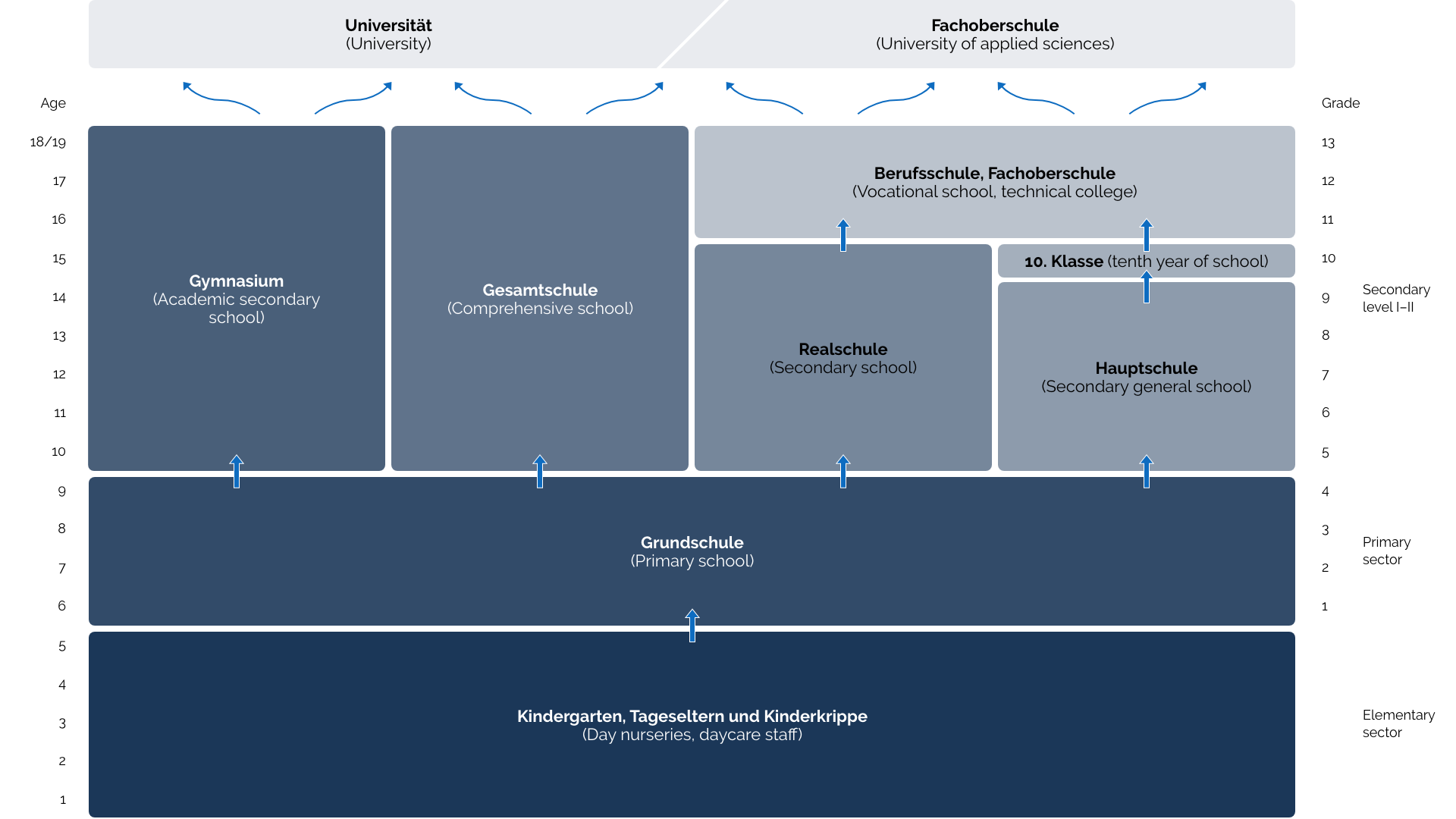
Generally speaking, however, children attend one of the various secondary schools once they have completed primary school, which in most states lasts for four years. There are three main types of secondary school:
- Hauptschule (lower secondary school)
- Realschule (intermediate secondary school)
- Gymnasium (grammar school)
In some states, the Hauptschule and Realschule are combined (integrierte Sekundarschule). There are also some other mixed types such as the Realschule plus or the Regelschule at which pupils can take either a lower secondary or an intermediate school-leaving certificate.
Gesamtschulen (comprehensive schools) are schools where pupils can normally acquire any of the different qualifications, including the higher education entrance qualification (Abitur). At comprehensive schools, pupils are taught together but streamed according to ability. This makes it easy for them to switch between the different school types.
Final exams
At a Hauptschule, pupils attend classes from year five to year nine or ten. Year ten is voluntary in some of Germany’s states. Pupils leave the Hauptschule with the Hauptschulabschluss (lower secondary school-leaving certificate).
Pupils at a Realschule and other secondary schools take exams called the Mittlere Reife (intermediate school-leaving certificate) at the end of year 10. If they do well in these exams, they can then attend the gymnasiale Oberstufe (the upper level of Gymnasium) to take their Abitur, or they can do a vocational training course.
Your children will be able to take the Abitur at a grammar school (Gymnasium) and at many comprehensive schools (Gesamtschule). The Abitur is the higher education entrance qualification. Abitur exams are taken in either year 12 or 13, depending on the type of school and the federal state.
By the way: it is possible to attend university without the Abitur, and the numbers of people doing so is growing. Most universities offer advice and information on their websites for prospective students without a higher education entrance qualification.
Full-day schools
Full-day schools (Ganztagsschulen) are now very common in Germany. At primary schools in particular, but also in most comprehensive schools, pupils are looked after all day. For pupils up to year 10, after-class supervision may be compulsory, partly compulsory or voluntary.
Good to know
Two out of three schools in Germany are full-day schools.
International schools can be found in many cities. Information can be obtained from the Association of German International Schools.
Children that had to flee their home countries are sometimes taught in so-called Willkommensklassen (welcome classes) until they have acquired basic German language skills.
More information
- An easy introduction to the German school system on the platform deutschland.de
- An overview over the German educational system on the Make it in Germany website
- Information for international researchers on childcare and schools on the EURAXESS website
- Information about the education system in Germany on the German Education Server