

Support making RiG more international!
Start SurveySupport making "Research in Germany" more international! Your expertise and commitment are the key to the further development of promoting the German research landscape. We invite you to take part in our online survey and share your valuable experiences and opinions. Duration: 7-10 min.
Please start the survey at the end of your visit.
Engineer of the immune system
Immunologist Kathrin de la Rosa investigates how the body’s own B cells protect us from infectious diseases. In the laboratory, she hopes to modify these cells in such a way that they produce powerful antibodies against pathogens which have overwhelmed our immune system until now.
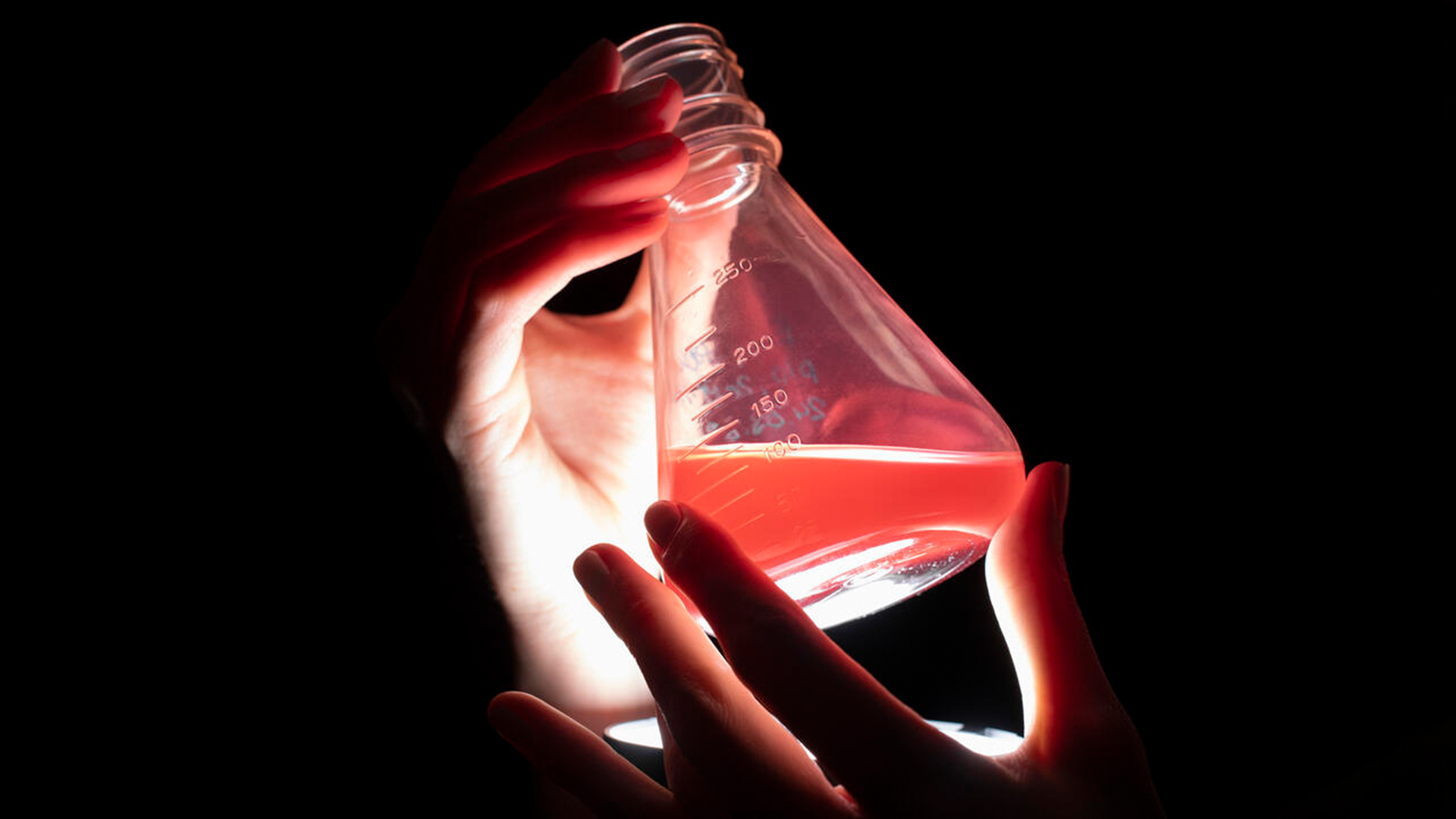
One of Kathrin de la Rosa’s many hopes floats in a murky, pale pink liquid. In the steady rhythm of a shaker, the solution sloshes back and forth in narrow-necked flasks at a constant 37 degrees Celsius. The cell lines in the flask are designed to produce artificially constructed variants of antibodies that recognize the spike proteins of the coronavirus strain SARS-CoV-2, i.e., the spikes on surface of the virus through which the virus infiltrates host cells. “We also use these cells to produce the viral proteins we employ in the blood samples of coronavirus patients to search for antibodies that bind to them and are effective against the coronavirus,” says de la Rosa, who heads the junior research group “Immune Mechanisms and Human Antibodies” at the Max Delbrück Center for Molecular Medicine (MDC). Though her face is hidden behind a mask, her eyes shine with the curiosity and determination that drive her to explore the mechanisms of the immune system.
One can imagine Kathrin de la Rosa as an engineer of the immune system. She copies her most successful tricks from nature so that we will be better protected against infectious diseases in the future. Above all, she has devoted herself to studying B cells, a type of white blood cell. These are able to form highly specialized antibodies that recognize and bind to intruders in the body. In this way, they attract defensive cells such as scavenger cells that destroy the pathogen. De la Rosa wants to modify the body’s own B cells in the laboratory so that they produce antibodies that are even more powerful than their natural counterparts. Her hope is to use the improved defense proteins to keep pathogens that overtax our immune system, such as HIV or coronaviruses, in check. One day it might be possible to supplement the immune system with such B cells and thus ensure protection – similar to the cell-based therapeutics already used against cancer.
“There’s an entire world behind every B cell”
It was an immunology lecture in undergraduate biology at the University of Freiburg that opened Kathrin de la Rosa’s eyes to B cells and antibodies. Previously, she had been interested in plants and biotechnological methods; now she became fascinated by immune defense processes. “It’s difficult to grasp what fascinated me. It’s a bit like falling in love,” says de la Rosa. She abandoned her plans to study biotechnology and chose immunobiology as her major instead. “What fascinated me was that there are millions of cells in our body, all of which are different and react to different pathogens.”
De la Rosa was so fascinated by the diversity of B cells and antibodies that she decided to delve deeper into their complexity. She began her first research project by studying one of the countless surface receptors through which B cells come into contact with their environment. She was trying to understand how a mutation in this receptor influences the immune response. “Behind every B cell there’s an entire world that raises countless questions,” says de la Rosa. She completed her PhD thesis at the Center for Chronic Immunodeficiency (CCI) of the University Medical Center Freiburg. The CCI investigates genetic defects that prevent B cells from doing their job – or doing it properly. She went to Switzerland as a postdoctoral fellow to work with the well-known immunologist Antonio Lanzavecchia at the Institute for Research in Biomedicine in Bellinzona. Here she concentrated on the power of antibodies to protect humans from herpes, influenza and malaria. She learned techniques to isolate antibodies and designed experiments to read and understand the processes of the immune system – and to use them for her own scientific purposes.
Discovery of a special antibody
Something unexpected happened during one of these experiments. Her team was searching for effective antibodies against malaria. What they found was a whole new class of antibodies that uses a trick to render the malaria pathogen Plasmodium falciparum harmless. This parasite evades an immune response by constantly changing its surface. But the antibodies turn the tables on it. They “steal” a segment of another gene, LAIR1, to form an antibody that is able to recognize the parasite – even when it changes its surface. “The LAIR1 receptor is normally located on the surface of immune cells and can inhibit them. The parasite seems to exploit this function,” says de la Rosa. “But with this new class of antibodies, the immune system can fight back.”
They almost oversaw this novel antibody, only noticing by chance in the lab that its genetic code was longer than usual. “At first we thought it was a mistake. But the result kept popping up,” says de la Rosa. The researchers sensed that this could be a groundbreaking discovery. But they remained skeptical. Together with her colleagues, de la Rosa studied the proteins produced by the B cells. These were also conspicuously large. After further experiments, it gradually became clear that the discovery had to be true. “The nice thing about science is that there is always another experiment to conduct, which unambiguously confirms an assumption – or doesn’t,” she says.
Two articles in Nature followed. She was invited to a conference, and spoke about the novel antibody in a session with renowned immunologists. She applied for an Emmy Noether Fellowship, was accepted and founded the junior research group “Immune Mechanisms and Human Antibodies” at the MDC in 2018.
Attacking the HI virus at its Achilles’ heel
One of the many questions that de la Rosa brought to Berlin was whether this capability of the newly discovered antibody could also be instrumental for other infections. She knew from her postdoctoral studies that up to ten percent of people in malaria regions possess the antibody with this foreign receptor. Europeans do not have it – but could produce it if needed, as the MDC team discovered. De la Rosa now wants to decipher which mechanisms lead to the formation of the new antibody class and develop antibody variants that are more effective against other pathogens than the natural variants. “We want to manipulate B cells so that they incorporate a receptor into antibodies that would make them extremely effective against, for example, HIV.”
If this project is successful, it could form the basis of an HIV vaccine. The antibodies with this built-in receptor would attack the virus at its Achilles’ heel. However, until then, a range of experiments could shatter her hypothesis. “One is always caught between hope, hard work, and the danger of failure,” says de la Rosa, who at 35 is currently the youngest group leader at the MDC.
“We are privileged to be able to research the virus”
Coronaviruses were already on de la Rosa’s research agenda in February 2018 – in second place, right behind HIV. “At that time, SARS-CoV-1 and MERS already existed, and spread quickly,” she says. Two years later, in February 2020, she looked at her cell phone while taking the suburban train to the MDC in Berlin-Buch and saw data from the first coronavirus wave in China. She decided to apply the techniques from the HIV project to SARS-CoV-2. Even though it could take years to manipulate B cells to produce potent antibodies against SARS-CoV-2, the analytical methods could be helpful much earlier. Using the proteins from the pale pink solution, she hopes to find out, among other things, which people are more likely to develop COVID-19 – and who should be vaccinated most urgently.
“We are privileged to be able to research the virus and there is currently a huge impulse to understand it better,” she says. One can see a certain restlessness shining in her eyes again, the will to conduct the next experiment. Now she is also conveying this curiosity to Charité medical students. “Vaccination, One of the Greatest Successes of Mankind” is the title of her lecture course. When it comes to antibodies and B cells, she says there’s almost no stopping her.
This article was published with the kind permission of the Max Delbrück Center for Molecular Medicine in the Helmholtz Association.