Support making RiG more international!
Take part in our online survey at the end of your visit and share your valuable experiences and opinions. Duration: 7-10 min.
Microswimmers switch swimming styles on command
Physicists at Leipzig University and Charles University in Prague have developed a method for changing the swimming style of tiny artificial microswimmers in real time. They can make a single microscopic particle switch at will between modes of swimming inspired by bacteria and algae. The researchers have thus turned a property that was previously fixed during production into a programmable parameter. They believe their findings pave the way for an evolutionary approach to the development of synthetic active matter. Their study has now been published in Nature Communications.
Sep 16, 2026, 6:24:33 PM
Susann Sika
, Universität Leipzig

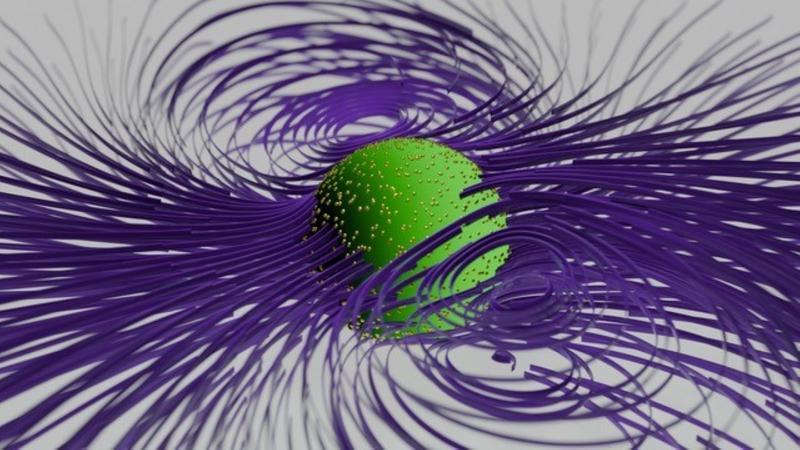
Microswimmers are objects generally only a few micrometres in size that move through fluids. They include both living microorganisms, such as bacteria and algae, and synthetically produced particles. The latter serve as physical models for understanding the complex interactions between biological microorganisms. Until now, it has not been possible to alter the swimming style of artificial microswimmers. However, researchers led by Professor Frank Cichos have now found a way to use light to switch the artificial particles between the swimming styles of bacteria and algae at will. Bacteria such as E. coli propel themselves using flagella at their rear, pushing themselves forwards. Algae such as Chlamydomonas beat flagella at their front, pulling themselves through the fluid. Bacteria swim with what might be described as rear-wheel drive, while algae use front-wheel drive. The two generate entirely different flow fields in the process. “Our work helps us understand what an ‘optimal’ swimmer actually means in reality. We show that the physical constraints of the swimming mechanism can prevent a swimmer from achieving the theoretical optimum,” explains doctoral researcher Lisa Rohde, first author of the study. According to Rohde, the same constraints also exist in nature. This may explain why evolution has produced swimming strategies in bacteria that, while not “optimal on paper”, are nevertheless extremely successful and widespread. The microswimmers used by the researchers in their experiments are transparent spheres a few micrometres in size, coated with tiny gold particles. When illuminated by a laser, the gold particles act as tiny, individually controllable heat sources. The laser can heat the surface of the particle but cannot cool it – a constraint that proved crucial. By projecting tailored intensity patterns onto the particle’s surface and adjusting them in real time to its movement, the researchers control the temperature distribution across the sphere. This temperature pattern propels the particle while also determining the flow field around it. Changing the light pattern changes the flow. The same particle can act as a pusher one moment and a puller the next. “The counterintuitive finding is that, at the same laser power, the slowest swimming style is actually the most efficient when it comes to achieving a particular speed. The fact that we can only heat and never cool fundamentally changes the optimisation landscape,” says Rohde. Professor Cichos, head of the Molecular Nanophotonics Group, adds: “Until now, a microswimmer’s hydrodynamic character was fixed at the point of production, much like an animal’s body structure. We can now use light to change it in real time and, for example, adapt it to the environment if needed.” Experiments on the collective behaviour of active matter, from bacterial turbulence to swarming, have so far been virtually impossible with conventional swimmers whose properties are fixed. This is now set to change. “In future, we want to combine this programmable control with machine learning so that microswimmers can learn which swimming style to use for a particular task. Ultimately, we could develop adaptive microswimmers and gain a better understanding of how swimming in viscoelastic mucus differs from swimming in water,” emphasises Rohde.