Support making RiG more international!
Take part in our online survey at the end of your visit and share your valuable experiences and opinions. Duration: 7-10 min.
Human and Disease Mobility in Late Antiquity
A study funded by the ROOTS Cluster of Excellence has identified a leprosy pathogen – previously undetected in Europe – in a 5th-century burial ground on the North Sea coast.
Nov 3, 2026, 5:01:10 PM
Jan Steffen
, Cluster of Excellence ROOTS - Social, Environmental, and Cultural Connectivity in Past Societies

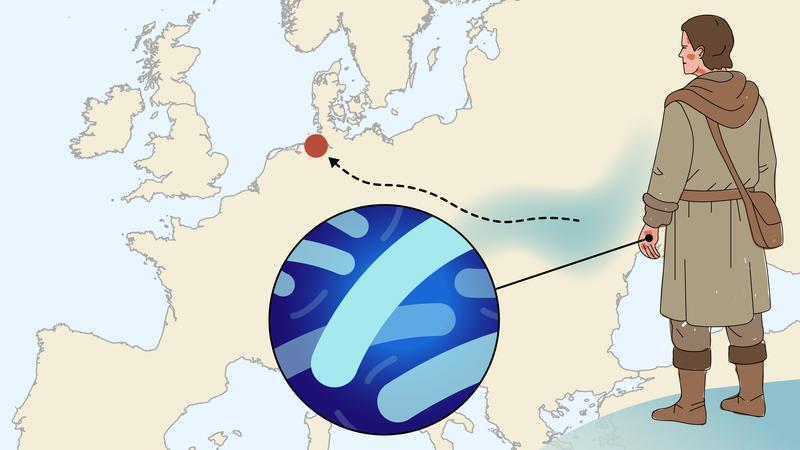
Visigothic and Vandal forces marched into Italy and conquered Rome; the Huns spread fear and terror on their campaigns through Western Europe; the Franks expanded their domain southwards – the 5th century was an era of profound, often violent upheavals in Europe, and at the same time one of great mobility. Researchers from the Institute of Clinical Molecular Biology (IKMB) at Christian-Albrechts-University in Kiel and the Lower Saxony Institute for Historical Coastal Research (NIhK) have now identified a specific example of this mobility in the Fallward burial ground in what is now the district of Cuxhaven. “Genetic analyses confirm that a man buried at Fallward originated from the Danube region. He was also infected with a very rare leprosy pathogen. He is the first individual from this group to have been identified in Europe,” says Daniel Myburgh of the IKMB, lead author of the study, which has now been published in the journal iScience. The Cuxhaven district’s archaeological heritage conservation department had already investigated the Fallward burial ground back in the 1990s. Thanks to the damp soil, wooden and textile grave goods were preserved in their entirety. Findings and artefacts from the burial site are currently being fully analysed for the first time as part of a project funded by the German Research Foundation (DFG) at the NIhK in Wilhelmshaven. The focus is on objects that were recovered in blocks at the time and stored in a frozen state, which the researchers will now examine under laboratory conditions. In this context, the Ancient DNA Working Group at the IKMB in Kiel received bone samples from eleven individuals in order to clarify possible genetic relationships and to detect traces of infectious diseases funded by the ROOTS Cluster of Excellence. The archaeological finds themselves already point to long-distance connections “Three of the individuals provided sufficient data for a population genetic analysis. The results were particularly striking in the case of one individual,” says the study’s lead researcher, Professor Ben Krause-Kyora of the IKMB The man had been buried in a boat along with numerous grave goods made of wood, pottery and metal. “The grave goods placed in the tomb aroused particular scientific interest; these included a chair, artfully decorated and carved from an alder trunk. Furthermore, the man possessed a late Roman military belt, which suggested that the deceased had had connections across great distances,” explains Prof. Dr Hauke Jöns of the NIhK. The new genetic analyses have confirmed these findings. They confirm that the man originated from the Danube region and that he had an unusual form of leprosy. The specific pathogen belongs to a group whose earliest known representative comes from Egypt, dating from between the 4th and 2nd centuries BC. It has not yet been detected in Central or Northern Europe. Genetic analyses also reveal the spread of diseases “Leprosy is a chronic disease. It can take years for clear symptoms to appear. The man had not yet suffered any bone damage. Either he was affected by an asymptomatic form of the disease, or the disease had so far only affected soft tissues. He may have travelled long distances whilst carrying the disease,” explains Professor Almut Nebel from the IKMB, who is also an author of the study. The genetic analyses thus confirm the picture of a man who, although buried on the North Sea coast, had his roots in the Danube region and had connections to south-eastern Europe and the Mediterranean. He presumably lived there for a certain period of time. “He could, for example, have been a mercenary in the Roman army who later settled between the Elbe and the Weser. Or he might have undertaken long journeys as a trader,” says Prof. Dr Ben Krause-Kyora. Even though the man’s exact origins remain unknown, the analyses highlight the complexity of individual life stories during Late Antiquity – and the mobility of pathogens in a world interconnected across vast distances.