Quantum technology research in Germany: faster, smarter, more precise

Quantum technologies use the principles of quantum physics to enable new ways of computing, sensing and communicating. Quantum computers are being explored for computational approaches that could benefit some AI applications, while quantum sensors can measure electromagnetic fields with exceptional sensitivity in specialised settings. Quantum communication – particularly quantum key distribution – can help detect attempts to intercept the exchange of encryption keys, offering a path toward more secure communications. Germany is already one of the leading centres of fundamental quantum physics research and now also aims to lead the field in industrial applications. 


The High-Tech Agenda Germany brings together targeted funding measures to support this ambition: it creates the necessary technical conditions, launches flagship projects and expands structures that bring research and application closer together. The goal is clear: by 2030, at least two fault-tolerant quantum computers at a European level of excellence are to be developed.

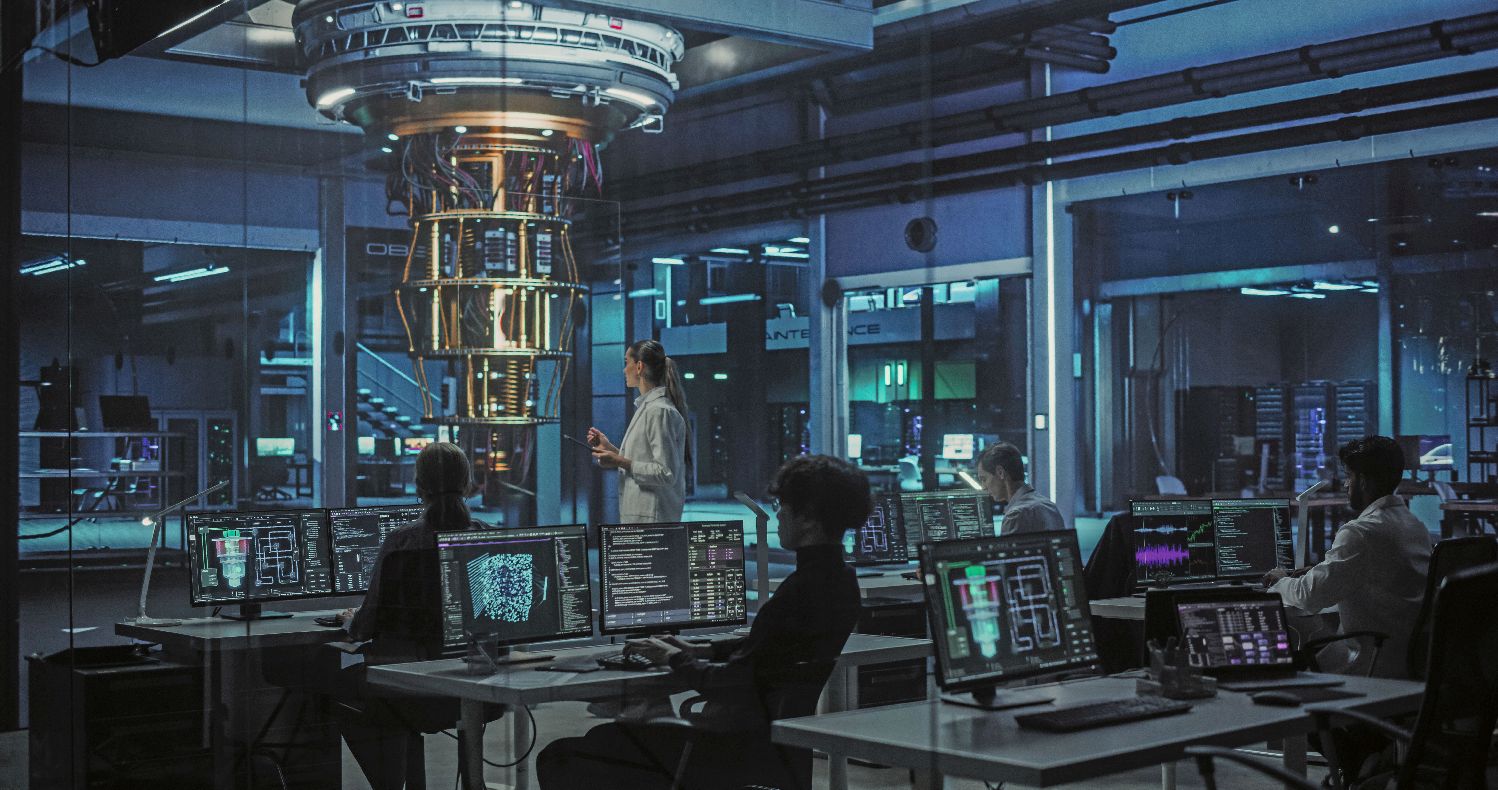
Research into quantum technologies is opening up new possibilities in computing, sensing and secure communication.

What are Germany’s strengths in quantum technologies?

Germany plays a leading role in quantum technology research. Its position is based on:

  • leading non-university research institutions such as the Max Planck Society, which ranked among the top five institutions by share of publications in 2024
  • world-leading universities with strong quantum research programmes, such as RWTH Aachen University and TU Munich
  • innovative strength: Germany ranks third worldwide for patents granted across quantum technologies (2000–2024)
GOOD TO KNOW

Upcoming "Find Your Future Research Destination" Episode: Quantum Technologies in Germany

Join us on 19 November 2026 for the next episode of our "Find Your Future Research Destination" series. Discover research opportunities in quantum technologies, meet representatives from three leading research institutions, and take part in a live Q&A session.

Learn more about the event and register here

What makes Germany’s quantum technology industry strong?

  • A dynamic environment: Germany ranks third for the number of new firms entering the quantum ecosystem (2015–2024).
  • Large companies with quantum research interests, including Airbus, BASF, Boehringer Ingelheim, Bosch, Volkswagen, SAP and Infineon.

Which recent German success stories stand out in quantum technologies?

.

Researchers in Germany are working to turn the principles of quantum physics into practical technologies for industry and society.

Researchers in Germany are working to turn the principles of quantum physics into practical technologies for industry and society.

  • Euro-Q-Exa: It is hosted at the Leibniz Supercomputing Centre (LRZ) in Munich and is part of the EuroHPC family of European quantum computers. It began operating in 2026.
  • Quantum simulation: In November 2025, JUPITER, Europe’s first exascale supercomputer, located in Jülich, simulated a quantum computer with 50 qubits – a new record.
  • JION: In 2026, the “Jülich trapped-ION quantum computer”, one of the world's most advanced quantum computers, went into operation at Forschungszentrum Jülich.
  • QUBE-II: The approximately ten-kilogram microsatellite was launched into space in 2026. It is intended to demonstrate how secret keys can be exchanged securely between a satellite and a ground station using quantum communication.

How is Germany helping to position Europe at the forefront of quantum computing?

Germany is one of the world’s most important research nations in quantum computing. It ranks third for scientific publications and second for patent applications worldwide, behind the United States.

The High-Tech Agenda Germany therefore places a particular focus on quantum computers. By 2030, at least two fault-tolerant systems at a European level of excellence are to be developed. Which technology platform will prevail is still not known.

A researcher stands between the computing racks of JUPITER, Europe’s first exascale supercomputer, at Forschungszentrum Jülich.

A researcher stands between the computing racks of JUPITER, Europe’s first exascale supercomputer, at Forschungszentrum Jülich.

JUPITER connects high-performance and quantum computing

The starting position is promising. JUPITER, Europe’s first exascale supercomputer and one of the world’s most powerful computers, is in operation in Jülich. The Jülich Supercomputing Centre at Forschungszentrum Jülich combines conventional high-performance computing with quantum computing research. Through the Jülich Unified Infrastructure for Quantum Computing (JUNIQ), researchers from academia and industry have access to modern quantum systems.

Euro-Q-Exa expands access to quantum computing in Europe

Since 2026, Europe’s Euro-Q-Exa has also been operating at the Leibniz Supercomputing Centre (LRZ) in Garching. The system has 54 qubits. A further system with 150 qubits is scheduled to be added by the end of 2026. Euro-Q-Exa is the second quantum computer that the LRZ has installed together with IQM Quantum Computers. Through the Munich Quantum Portal (MQP), the LRZ makes the systems available to researchers throughout Europe.
 

Quantum sensing in Germany: technologies and applications

Compared with other leading industrialised countries, Germany has an exceptionally strong ecosystem for quantum sensing. A particularly large number of companies are active in this field of technology, and many patents are being filed.

German companies are developing practical quantum sensing applications

The Stuttgart-based start-up Q.ANT, a subsidiary of TRUMPF, developed the world’s first industrially suitable quantum sensors together with sensor manufacturer SICK in 2022. Bosch is also conducting intensive research into quantum technologies. Among other things, the company is developing sensors for autonomous systems in satellites and quantum magnetometers for use in neurology.

GOOD TO KNOW

How is Germany spearheading the precision revolution with quantum sensing?

Quantum sensors measure time, electric and magnetic fields and gravitational forces with unprecedented accuracy. German universities, research institutions and companies are developing these technologies at the forefront of the field.

Researchers examine optical equipment in a laser laboratory at the Fraunhofer Institute for Applied Solid State Physics IAF

Researchers examine optical equipment in a laser laboratory at the Fraunhofer Institute for Applied Solid State Physics IAF.

The Fraunhofer Institute for Applied Solid State Physics IAF is also advancing quantum sensing. Its diamond-based sensors detect magnetic and electric fields – from just a few nanometres to individual electron and nuclear spins.

This precision opens up a wide range of applications: quantum sensors can make navigation systems independent of global navigation satellite systems (GNSS) and improve molecular analysis in medical technology.

How is Germany developing highly secure networks through quantum communication?

Germany is advancing quantum communication through dedicated test environments, initiatives such as QuNET, Q-net-Q and EuroQCI and satellite-based QKD research with Qube II.

Secure communication is a cornerstone of free societies and essential to the operation of critical infrastructure. This requires quantum-safe encryption methods. Quantum key distribution (QKD) is an important part of this technology.

QuNET is developing satellite-based quantum key distribution to enable secure and efficient key exchange over long distances. While fibre-optic links are limited to a few hundred kilometres, satellite-based quantum communication can connect locations across far greater distances on Earth.

QuNET is developing satellite-based quantum key distribution to enable secure and efficient key exchange over long distances.

Germany offers more than two dozen quantum communication test environments

For this important branch of technology, Germany offers more than two dozen test environments where novel technologies, protocols and use cases can be tested and verified. Prominent examples include the QuNET initiative, which involves the Fraunhofer-Gesellschaft, the Max Planck Society, the German Aerospace Center and Friedrich-Alexander-Universität Erlangen-Nürnberg; the now successfully completed Q-net-Q initiative, which is the German branch of the European EuroQCI initiative; and the Munich Quantum Network (MuQuaNet) (only in German), which was established as the first quantum-safe network in the Munich region.

QUBE-II is testing satellite-based quantum key distribution

The aim of Qube-II is to demonstrate complete quantum key distribution (QKD) between a microsatellite (CubeSat) and a ground station. The lightweight, approximately ten-kilogram satellite entered orbit in 2026. Exchanging secret keys between several ground stations via satellite enables worldwide, quantum-safe communication.

Which are Germany’s leading quantum technology ecosystems?

Germany already has a strong quantum technology ecosystem. Key centres include Munich and the wider Bavarian region, Baden-Württemberg in south-west Germany and North Rhine-Westphalia, with major research centres in Jülich, Aachen and Cologne.

Laboratory research is laying the foundations for the next generation of quantum computers, sensors and communication systems in Germany.

What makes Munich and Bavaria a quantum technology hub?

Key focus: full-stack quantum computing hardware, software and fundamental research, for example at:


What is Baden-Württemberg’s focus in quantum technologies?

Key focus: quantum sensing, diamond-based quantum technologies and integrated hardware, for example at:


What is North Rhine-Westphalia’s focus in quantum technologies?

Key focus: supercomputing integration and quantum materials, for example at:

More information on quantum technology research in Germany

Find pioneering research institutions in quantum technology

  • European Quantum Communication Infrastructure – EuroQCI

  • Center of Excellence in Photonics: QuNET

Key technologies for tomorrow: The High-Tech Agenda Germany

Discover the six key technologies at the heart of Germany’s High-Tech Agenda: artificial intelligence, quantum technologies, microelectronics, biotechnology, fusion energy and battery technology. This booklet highlights the strategic goals, innovation roadmaps and flagship initiatives that are designed to strengthen Germany’s technological sovereignty, accelerate the transfer of research into application, and boost competitiveness in areas critical to the future of industry and society. 

A quick guide to research funding in Germany

There are a few core paths: paid positions, scholarships/fellowships, programme-based places, and project/PI grants that create jobs. This page explains the funding landscape in Germany for students, PhD researchers, postdocs and established academics.