Support making RiG more international!
Take part in our online survey at the end of your visit and share your valuable experiences and opinions. Duration: 7-10 min.
Publication in Cell Death & Disease: How damaged mitochondria may contribute to liver disease
As the “power house of the cells”, mitochondria supply cells with energy. They also play an important role in metabolism. The Institute of Biochemistry and Molecular Biology I at Heinrich Heine University Düsseldorf (HHU) and University Hospital Düsseldorf (UKD) are researching the role of mitochondria in the development of certain diseases. In a recent study, the researchers from the Institute show how damaged mitochondria may contribute to liver disease. The researchers led by Principal Investigator Dr Ruchika Anand have now published their findings in the scientific journal Cell Death & Disease.
Oct 1, 2026, 2:00:00 PM
Anne Wansing
, Heinrich-Heine-Universität Düsseldorf

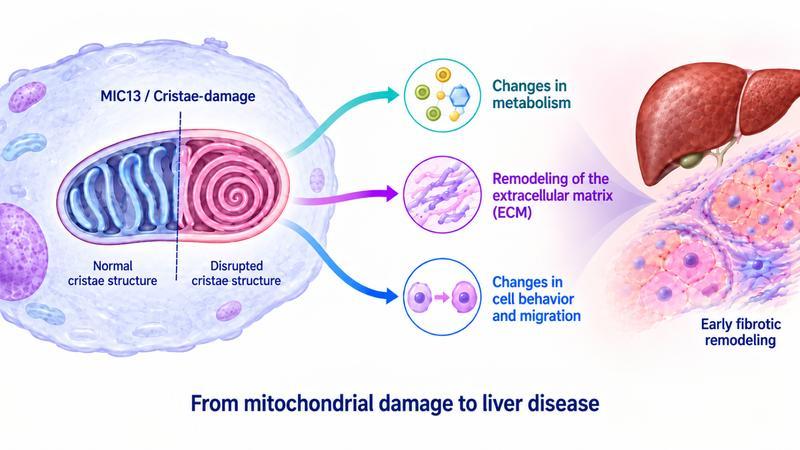
Disorders attributable to damaged mitochondria are referred to as mitochondriopathies. These also include severe mitochondrial liver disease, whereby the liver can be affected in around 20% of mitochondriopathies. The research focuses on the exact processes in the cell that contribute to the development of mitochondriopathies. The researchers led by Principal Investigator Dr Ruchika Anand have now identified a mechanism in the mitochondria, which could contribute to the development of mitochondrial liver disease. They studied MIC13, a protein that helps organise the inner mitochondrial membrane and its characteristic folds, known as cristae. They investigated a disease-causing MIC13 variant associated with early-onset mitochondrial hepatoencephalopathy, a severe mitochondrial liver disorder. Cell models derived from pluripotent stem cells were used as the basis for the study. The researchers succeeded in genetically modifying these cells in such a way that they generated liver cells displaying key features of the mitochondrial disease. The development of these models expands the previously limited options for researching this mitochondriopathy. The researchers demonstrated that disruption of mitochondrial cristae was accompanied by extensive changes in cellular metabolism, including alterations in amino-acid, lipid and energy metabolism. These metabolic changes were also associated with changes in the extracellular matrix, including increased collagen accumulation and altered cell migration. The extracellular matrix provides structural support around cells and helps regulate how they communicate, move and respond to their environment. Changes in the extracellular matrix are an important feature of tissue remodelling. The findings thus suggest that mitochondrial dysfunction may influence the extracellular environment of liver cells at an early stage of disease, rather than these changes being simply a consequence of advanced liver damage. Together, the findings reveal a link between mitochondrial architecture, metabolism and early fibrotic remodelling, highlighting how mitochondrial defects may contribute to tissue-specific disease. The cell model used also provides a platform to investigate these mechanisms further and identify potential metabolic or molecular vulnerabilities for future therapeutic strategies. In addition to Dr Ruchika Anand, Alexander Becker (Institute of Biochemistry and Molecular Biology I, HHU) and Professor Dr Felix Distelmaier (Department of General Paediatrics, Neonatology and Paediatric Cardiology, UKD), among others, were also involved in Düsseldorf. Within the framework of the study, they also collaborated with Dr Andrea Rossi from the Leibniz Research Institute for Environmental Medicine in Düsseldorf and Dr Thomas Eichmann from the Medical University of Graz.